
Salt, sun and wind off the ocean are hard on a roof, and the metal parts usually give out first. If you have a leak or storm damage, roof repair in Pompano Beach starts with one call to One Call Home Pros. We connect you with a vetted, licensed, insured local roofing professional who inspects the roof and repairs it. One Call holds no roofing licence and is not the contractor. We match the right pro to your home, look after the arrangements and stay with the job through to the end.


Why Pompano Beach homes need roof repair
Pompano Beach is one of the most varied places in the county to look after a roof. Along the beach stand condominium towers with flat roofs and rooftop equipment. Inland, on the mainland, are streets of older single-family houses, many low and spread out, with tile or shingle roofs that have been patched over the years. Along the corridor there is newer development, with roofs that are recent but already facing the same coastal weather.
What ties them together is the coast. Salt air carries well inland on an onshore breeze. It is known for shortening the life of outdoor AC equipment near the water, and it works on the metal of a roof in the same way: flashing, drip edge, fasteners, vent caps and gutters. Add the open exposure to ocean wind and the rain it drives sideways, and many leaks here start at metal and edges rather than in the middle of the roof.
Coastal roof repairs we arrange
Leaks in driven rain
Water that appears when rain comes in sideways off the water. The pro looks at edges, walls and flashing on the windward side.
Cracked or loose tile
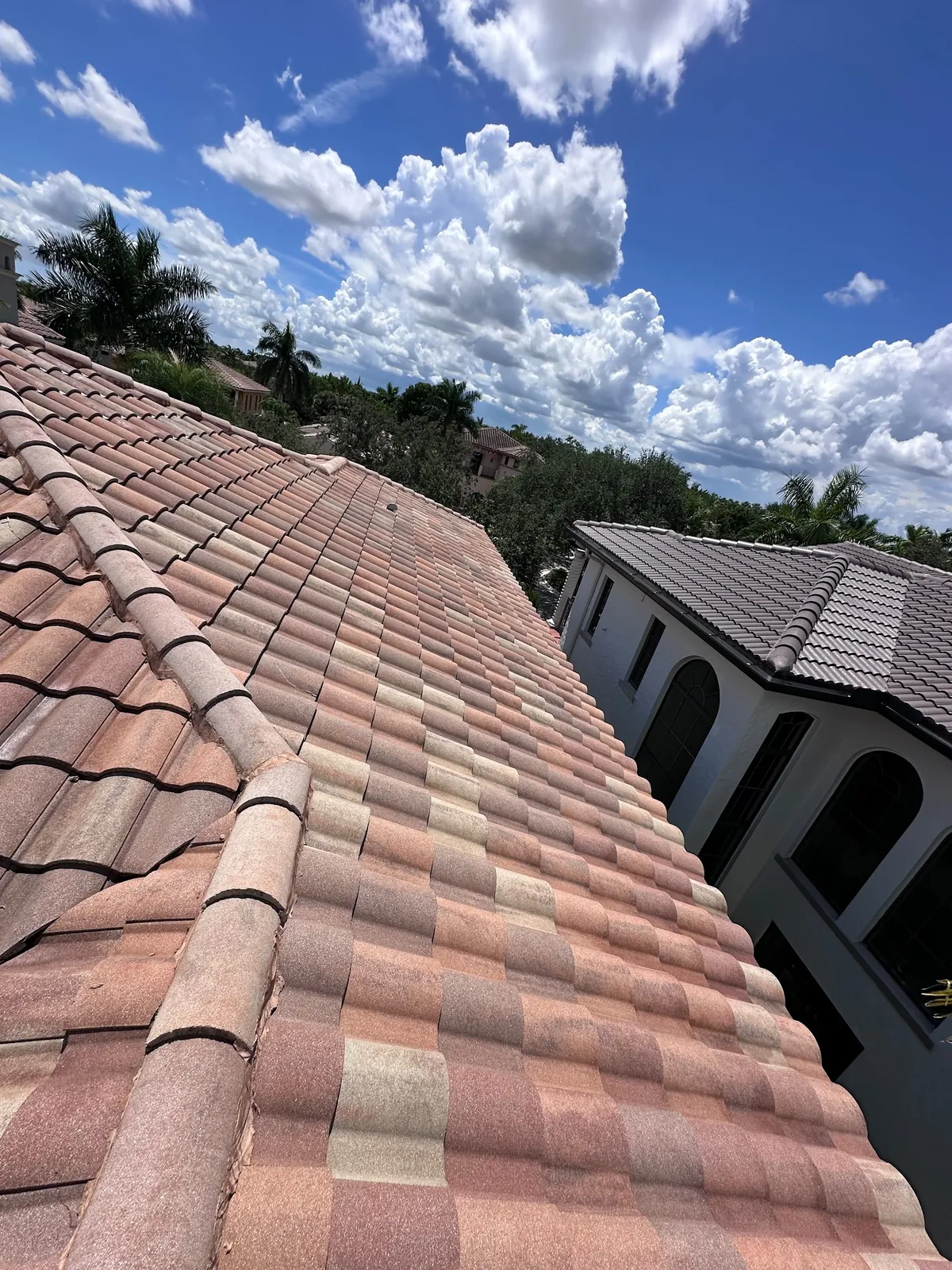
Concrete and clay tile that has cracked, lifted or blown away, exposing the underlayment.
Lifted shingles
Asphalt shingles torn or lifted by onshore wind, and shingles worn thin by sun and salt.
Corroded flashing
Rusted or pitted metal at walls, valleys, vents and the roof edge, a common coastal failure point.
Fascia and soffit
Rotted fascia and loose soffit at the eaves, where salt-laden rain and animals get in.
Storm damage records
Photos and a written report after wind damage, for your insurer.
What to do while it is leaking
You cannot fix a roof from inside, but you can stop a leak from ruining a room:
- Catch the water. A bucket, a storage bin or a stockpot, with towels laid around it.
- Clear the floor below and nearby. Furniture, rugs, electronics and documents first.
- Keep away from a ceiling that is bulging with water.
- Shut off the breaker for any fixture the water is near.
- Photograph the damage with the date and time.
Stay off the roof. Coastal roofs are often slick with salt film and damp, and wind near the water makes ladders unsafe even on a clear day.
Salt air and the metal on your roof
Most roofs depend on metal at their weakest points. Flashing turns water away where a roof meets a wall, a chimney or another roof plane. Drip edge carries it off the eaves. Valley metal channels it down the joins between slopes. Vent caps and pipe collars seal the openings. Fasteners hold tile and shingle down.
Near the water, all of that metal corrodes faster. Galvanised steel rusts once its coating wears. Pitting in a flashing can open a pinhole that leaks in every rain. A rusted fastener lets go of its tile in a strong gust. Gutters and their hangers corrode and sag, sending water behind the fascia.
When you call about roof repair in Pompano Beach, it is worth saying how close the home is to the beach or the Intracoastal. The pro will look harder at the metal, and may suggest replacement flashing in a material better suited to salt exposure. Ask them what they would use and why.
Wind that comes straight off the water
Homes close to the coast take the wind with little to slow it down. Onshore wind hits ridges, hips, gable ends and the first rows of tile at the eave hardest. It can lift tile that is fastened well enough for an inland roof, and it drives rain up under laps and flashing that would shed water in calm weather.
That is why many coastal leaks only show in certain storms. A drip that appears with a strong easterly and never in a still downpour is almost always on the windward side, at an edge, a wall flashing or a ridge. Keep a note of the wind direction when the leak appears. It saves the pro time and points them to the right slope.
Older mainland houses
Inland from the beach, many of Pompano Beach’s single-family houses are older and lower, some with flat or low-slope sections, carports and additions. Their roofs often carry a history of repairs. A pro working on one of these houses commonly finds:
- Patches over patches. Earlier repairs in roofing cement around vents and walls, sometimes several layers thick.
- Tired decking. Plywood or planks softened by slow leaks, which will not hold new fasteners well.
- Additions tied in by hand. A room or a porch added later, with its own low roof meeting the main roof along a flashing line.
- Flat sections. Built-up or rolled roofs that hold water longer and fail at seams and edges.
These are repairs, not automatically a new roof. What matters is that the pro reaches the real cause rather than adding another patch. Ask to see photos of what is under the surface.
Rooftop AC stands and equipment
Salt air is hard on outdoor AC equipment near the water, and on some older houses and low-rise buildings that equipment sits on the roof, on a metal stand. That puts two coastal problems in one place. The stand corrodes, and its legs pass through or bolt onto the roof covering, each one a seal that can fail. The condensate line from the unit can also drip onto the roof or into a valley and wear a path through the surface over time.
If your stain sits below rooftop equipment, say so when you call. Roof repair in Pompano Beach around an AC stand usually means the roofer resealing or reflashing the stand’s supports and the roof around them. The AC unit itself is a separate trade, so if the stand needs lifting or replacing, ask the roofer how they coordinate with the AC side.
When a permit comes into it
Small fixes, like resealing a vent boot, are quick. Bigger repairs, such as replacing a section of tile and underlayment, need a building permit and an inspection in Florida. The licensed roofer applies for it; you do not. Coastal Broward is inside the state’s High-Velocity Hurricane Zone, where the standards for fastening tile and laying underlayment are strict, and a roofer used to roof repair in Pompano Beach works to them as a matter of course. If your home is in a community with an association, check whether it also wants to approve the materials or the contractor before the work date.
Newer homes along the corridor
Newer houses and townhouses built along the corridor have recent roofs, but recent does not mean immune. In the coastal air, details such as vent boots, flashing sealant and fasteners can age faster than the tile or shingle around them. Leaks on newer roofs usually come from one detail rather than the whole surface.
If your home is new enough that a builder’s or installer’s warranty may still apply, find that paperwork before you call. Tell One Call, and the pro will know what they are working with. On newer townhouse rows along the corridor, check too whether the roof over your unit is yours or the association’s, because that decides who books the repair. Newer communities also tend to have tight rules on tile colour and on when contractors may work, and a quick call to the management office before the visit avoids a wasted trip. In a community with an association, check whether it needs to approve materials or contractor access before work starts.
Skylights, solar mounts and other openings
Anything fixed through a roof near the water carries the same two risks: a seal that dries out in the sun, and metal that corrodes in the salt. Skylight frames, solar panel mounts, satellite brackets and exhaust vents all qualify. A skylight that weeps at its corners in heavy rain, or a stain that lines up with a row of panel mounts, points the pro straight at that opening.
If solar panels are involved, check the installer’s paperwork before the visit. Panels may need to be lifted to reach the roof beneath them, and the panel owner or installer may need to take part. Tell One Call what is on the roof when you call, so the right roofer is matched from the start.
Condo towers and who looks after the roof
If you own a unit in one of the beachfront towers, the roof is almost certainly common property, maintained by the association. A leak in a top-floor unit, or water coming through from a rooftop mechanical area, is a matter for the building manager. Report it in writing, with dated photos, and keep your copy.
Tower roofs are usually flat or low-slope membranes, with drains, parapet walls and rooftop equipment. They are a different job from a house roof. The pros One Call works with take condo high-rise jobs and flat roofs, so if you sit on a condo board or manage a building and need a licensed roofer, call One Call and describe the building, the roof and the problem.

Tile, shingle and low-slope roofs near the beach
Each roof type has its coastal weak point.
Tile. The tile sheds most of the water. The underlayment beneath does the waterproofing, and near the beach the tile fasteners matter as much as the tile. Corroded fasteners let tile loosen in wind. Repair means replacing broken tile, checking the fasteners and the underlayment in that area, and refastening to current standards.
Shingle. Shingles lose granules faster in sun and salt, and lose their seal strip in heat. Onshore wind then lifts the tabs. Individual shingles can often be replaced if the rest of the roof is still flexible.
Low-slope and flat. Water sits longer, and salt residue can collect where it pools. Seams, edges and drains are the usual problems.
After a coastal storm
Once the wind has dropped and it is safe, look at the roof from the street and the yard. Check the windward side first. Look for missing or broken tile, peeled shingles, flashing bent away from walls, and soffit panels hanging loose at the eaves. Collect any debris in the yard. Inside, watch the ceilings and the tops of exterior walls for several days.
Salt spray after a storm can leave a film on the roof and on the metal. It is not something to wash off yourself from a ladder. Mention it to the pro, who can check the flashing for fresh corrosion while on the roof. If a section is open to the weather, the pro can put on a temporary cover or tarp before the repair. Do not go up yourself.
Documenting storm damage
Insurers want to see what happened, where and when. Your claim is with your insurer, and the pro is not your adjuster, but the pro can give you the part of the record you cannot safely produce yourself: photos taken on the roof, and a written description of the damage and the repair. Put them together with your own dated photos from inside and from the ground. Keep any debris until the claim is settled.
Humidity in the roof space
Coastal air is damp as well as salty. In an attic or roof space with poor ventilation, that moisture condenses on the underside of the roof deck on cool nights and drips onto insulation and ceilings. It can look exactly like a leak. Signs that it may be condensation rather than rain getting in: the damp appears on dry mornings, it is spread over a wide area instead of one spot, and fasteners on the underside of the deck are rusty all over. A roofer can tell the difference, and can check that soffit and ridge vents are open and working.
The roof edge in salt air
The eaves take sun, rain and salt. Fascia boards rot when gutters overflow behind them, and gutter hangers corrode and let the gutter sag. Soffit panels warp or blow loose, and the gap that follows lets in water and animals. The pro replaces rotted fascia, refits or replaces soffit, and fits or replaces drip edge so water leaves the roof cleanly. Near the beach, ask what material they would use for the new drip edge and fasteners.
How a repair comes together
When you call, tell One Call:
- where the water shows, and whether it comes with wind from one direction,
- what the roof is made of, if you know,
- how close the home is to the water,
- whether it is a house, a townhouse or a condo, and who looks after the roof.
We match a vetted roofer, licensed and insured for your roof type, who works in Pompano Beach. The pro inspects, finds where the water gets in and explains the repair before starting. If the work needs a permit, the licensed pro applies for it. If the next heavy rain shows a drip, tell One Call and we follow it up with the pro.
You pay One Call for the job, and One Call pays the pro. Before work starts, ask what the price covers, including any metal that needs replacing. For larger roof work, financing is available; ask about it when you call. If the pro finds the roof has failed more widely, they will say so, and the roofing pros One Call works with take on full re-roofs too.
The same service is arranged on either side of the city, through roof repair in Coconut Creek and roof repair in Fort Lauderdale.
Questions from Pompano Beach
Why does my roof only leak in some storms?
Near the coast, wind drives rain sideways under tile laps and flashing. A leak that appears only with wind from one direction is usually on that side of the roof, at an edge, a wall or a ridge. Note the wind direction when it happens.
Does salt air really affect the roof?
It affects the metal on it. Flashing, drip edge, fasteners, vent caps and gutters corrode faster near the water, and many coastal leaks start there.
Water is coming into my top-floor condo. Who handles it?
In a condominium the roof is common property, so report it to the building manager in writing, with photos. The association arranges the roof repair.
My house is fairly new. Should it be leaking?
New roofs can still leak at one detail, such as a vent boot or a flashing. If a builder’s or installer’s warranty may still apply, find the paperwork before you call.
Have the roof looked at
Tell us where the water shows and how close you are to the water. One Call matches you with a vetted, licensed roofer in Pompano Beach and stays with the job until it is done.