
If water is coming through a ceiling, move what you can out of its way, put a container under the drip and keep off the roof. Then call One Call. For roof repair in Parkland, One Call Home Pros connects you with a vetted, licensed, insured local roofing professional who finds where the water gets in and repairs it. One Call is not a roofing company and holds no roofing licence. We take the details, choose the right pro for your roof and stay with the job until it is done.


Why Parkland homes need careful roof work
Much of Parkland was built from the 2000s onward, on big lots, with large single-family houses. Newer does not mean leak-proof. A large house usually has a large and complicated roof: several levels, hips and valleys, upper walls meeting lower roof sections, and many vent pipes and skylights cutting through. Every one of those joins is a place where water can find a path once flashing or sealant ages in the sun.
The other local reality is the homeowners association. Most Parkland communities have architectural rules that cover anything visible from the street, and a roof is about as visible as it gets. Tile colour, profile and even the type of ridge cap can need approval before a pro replaces a section. A roofer who works on Parkland houses expects that step and can give you the material details your association asks for.
Roof problems a Parkland pro handles
Leaks during rain
Water at a ceiling, a wall or around a skylight. The pro follows it back to where it enters, which on a multi-level roof is often well away from the stain.
Cracked or slipped tile
Concrete and clay tiles broken by wind, falling branches or foot traffic, and tiles that have slid out of line and left the underlayment exposed.
Wind-lifted shingles
Shingles that a gust has lifted or creased, on houses or detached structures roofed in asphalt rather than tile.
Flashing and pipe boots
Step and wall flashing where an upper storey meets a lower roof, valley metal, and the rubber or lead boots around plumbing vents.
Soffit and fascia
Long runs of fascia and soffit around a big footprint, where a rotted board or loose panel lets water and animals into the eaves.
Storm records
Photos and a written description after wind damage, ready for your insurer and, where needed, your association.
While the water is still coming in
The first hour matters more for the inside of the house than for the roof. A few things limit the damage while you wait for the pro:
- Clear furniture, rugs and electronics from under the drip, and put down a bucket with towels around it.
- If the ceiling is sagging with trapped water, keep everyone out of that room. Do not poke it.
- If water is running near a light fitting, a ceiling fan or an outlet, switch that circuit off at the panel.
- On a two-storey house, check the rooms directly below the wet room too. Water travels down through floors and walls.
- Photograph the stain, the water and anything damaged, and note the time and the weather.
Then call One Call or send the quote request. Roof repair in Parkland often starts with exactly these notes: which room, which floor, and whether it only leaks when the wind blows from one side.
Large roofs have more joins
A simple roof is a few flat planes and a ridge. Many Parkland houses are far from simple. A two-storey house with a single-storey wing, a covered lanai, a garage with its own roof and a front entry tower can have a dozen separate planes meeting at different angles. Water does not respect where one section ends and another begins.
The weak points on these roofs are almost always the transitions:
- Wall-to-roof joins. Where a lower roof runs into the wall of an upper storey, step flashing and counter-flashing carry water away from the stucco. When the sealant behind that flashing dries out, water runs down the inside of the wall and shows up as a stain well below.
- Valleys. Two roof planes meeting in a valley channel a lot of water. Debris collects there, and the metal or underlayment in the valley wears faster than the field of the roof.
- Penetrations. Plumbing vents, exhaust fans and skylights each need their own seal. On a large house there are many of them.
- Lanai and porch tie-ins. A covered outdoor area added to the main roof creates another join, often at a lower pitch, where water slows down.
When you call about roof repair in Parkland, it helps to say which part of the house the stain is under, whether it is upstairs or down, and whether the room sits below a lower roof section or below the main roof. That points the pro to the right transition before they ever climb up.
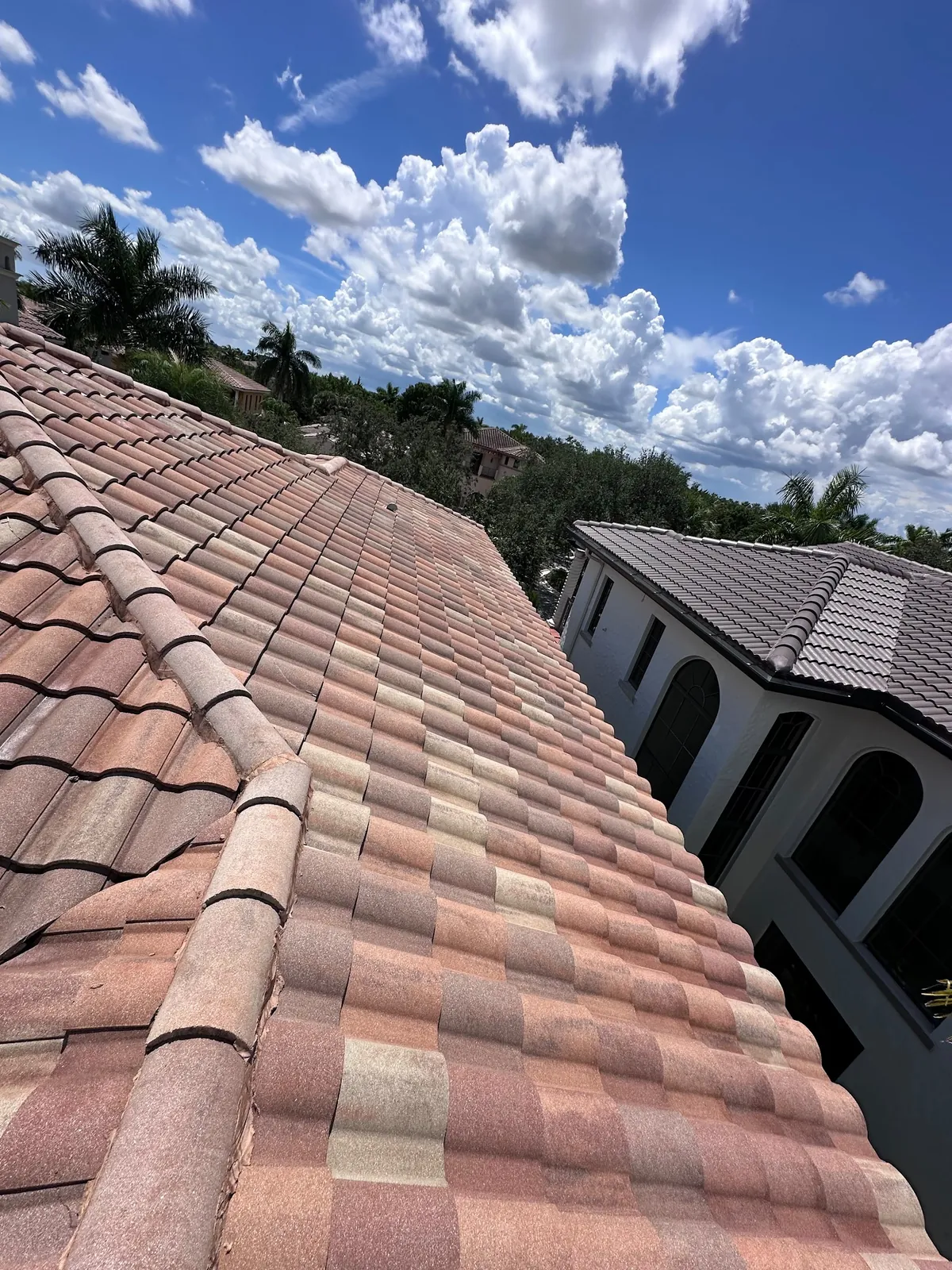
Matching tile under association rules
Tile on a newer house is usually a concrete profile in a colour the developer or association chose. When a few tiles crack, the repair is straightforward in principle: lift the broken tiles, check the underlayment beneath, and set new tiles in their place. In practice, the new tiles have to match.
A good match matters in Parkland for two reasons. It looks right, and your association may require it. Some communities keep a list of approved roof tile colours and profiles. Others ask you to submit the material before work starts on anything the street can see. Here is how that usually goes:
- The pro inspects the roof and tells you what has to be replaced and what tile the roof carries now.
- You check your association’s architectural guidelines, or ask the management company, whether a repair of this size needs approval.
- If it does, you submit the details the pro gives you: the tile maker and colour where known, the profile, and the area involved.
- Once the association agrees, the pro schedules the repair.
Tile can fade in the sun, so even the same product may look a shade different at first. Ask the pro how close a match they can get, and whether they have spare tiles from the original batch on hand or need to order. If your builder left spare tiles in the garage, mention it. They are often the best match there is.
When a newer roof leaks
A roof that is not old can still leak. The causes are usually different from those on a worn-out roof. Instead of tired underlayment across the whole surface, the problem tends to be one detail: a flashing that was never sealed well, a vent boot that has cracked in the sun, a tile that was cracked during another trade’s visit to the roof, or a gutter that overflows behind the fascia.
That is good news in one sense. A single failing detail is a repair, not a replacement. It also means the leak can be hard to find, because the rest of the roof looks fine from the ground. The pro may need to lift tiles around the suspect area to see the underlayment, or run water over one section at a time to see where it comes through.
If your house is recent enough that the roof may still be under a builder’s or installer’s warranty, look for that paperwork before you call. Tell One Call if a builder’s or installer’s warranty is in play, so the pro knows what they are walking into.
Storm season on open lots
Big lots bring open space around the house, and many Parkland properties back onto lakes, preserves or golf course land. Open ground means wind arrives with little to slow it down. Hips and ridges facing the open side take the worst of a gust, and ridge tiles and edge tiles are the first to loosen.
After a storm, walk around the house rather than climbing anything:
- Look at each roof plane from the yard, using binoculars if you have them, for tiles that are missing, broken or out of line.
- Check the ridge lines, where the caps should run straight and unbroken.
- Walk the lawn, the pool deck and the lanai screen for pieces of tile or flashing.
- Look at the soffits for panels that have dropped or bowed.
- Check upstairs ceilings and closets over the next few days. Wind-driven rain can take time to show.
If you find damage, take dated photos before anything is moved, and keep any broken pieces. If part of the roof is open to the weather, the pro can put a temporary cover or tarp on it before the full repair. Do not go up yourself, especially on tile, which breaks under foot and is slick when wet.

Skylights, solar mounts and other openings
Larger houses tend to carry more things that pass through the roof. Skylights over a stairwell or a kitchen, solar panel mounts, satellite brackets, attic fans and extra plumbing vents for several bathrooms all puncture the waterproof layer. Each one depends on a seal or a flashing kit, and each one ages at its own rate.
A skylight leak often looks like condensation at first: drops on the frame, a damp ring on the drywall around the shaft. If the drip gets worse in heavy rain rather than on cool mornings, it is more likely the flashing around the skylight than condensation. Mounts for panels and dishes are a common source of slow leaks when their bolts were sealed with nothing more than a bead of caulk.
Tell One Call what sits on your roof when you call. Roof repair in Parkland around solar mounts in particular may need the panel owner or installer involved, so check your solar paperwork before the pro arrives.
Insurance records for a larger home
Damage to a large roof can involve several areas at once, and an insurer wants to know exactly what happened where. The claim is between you and your insurer. The pro is not your adjuster. What the pro can do is give you a clear record:
- Photos from the roof itself, which you cannot safely take, showing each damaged area.
- A written description of what they found, section by section.
- A description of the repair and the materials it calls for.
Keep your own photos from the ground and from inside, with the date, alongside that record. If the association needs to approve the repair materials, a copy of the same description often answers their questions too.
Soffit and fascia around a big footprint
A large house has a long roof edge. That means a lot of fascia board and soffit, much of it high up on the second storey where you rarely look. Sprinklers, overflowing gutters and years of rain all work on that edge. A fascia board that has started to rot can let water behind the gutter and into the eaves. A soffit panel that has come loose is an open door for rats, squirrels and birds into the attic space.
The pro repairs or replaces the damaged sections and checks the drip edge, so water leaves the roof cleanly instead of running behind the board. If the soffit is vented, the replacement should keep the attic ventilation working. On a house with an association, the finish colour of the fascia may need to match the community standard, so ask the pro what paint or finish they will use.
What happens after you call One Call
The process is the same whether the problem is one cracked tile or a storm-damaged hip:
- You describe it. Where the water shows, which part of the roof is above it, what the roof is made of if you know, and whether a storm came first.
- We choose the pro. One Call matches a vetted roofer who is licensed and insured for your roof type, tile or shingle, and who works in Parkland.
- The pro inspects. They get on the roof, find the source and tell you what the repair involves before any work starts.
- You agree to the work. Ask what the price covers and whether any part needs association approval or a permit.
- The pro repairs it. If a permit is needed, the licensed pro pulls it.
- One Call follows up. If the next heavy rain shows the leak is not fixed, tell us and we take it from there.
Looking in the attic safely
If your house has an attic hatch you can reach without strain, a look inside after rain can tell the pro a lot. Take a torch and stay on the joists or any boarded walkway, never on the drywall between them, which will not hold your weight. Look for wet insulation, dark streaks on the underside of the roof deck, or daylight where there should be none. Do not go up in the heat of the afternoon, when a Florida attic gets dangerously hot, and skip it altogether if the hatch is high or awkward. A photo of what you saw is enough. The pro does the rest from the roof.
Paying for the repair
You pay One Call for the job, and One Call pays the pro. Ask what the price covers before the work starts: the tiles, the underlayment beneath them, any flashing, and the clean-up. For larger roof work, financing is available; ask about it when you call.
Repair, not re-roof
This page is about repairs: leaks, broken tile, flashing, the roof edge and storm damage. On most houses here, roof repair in Parkland is what the roof needs, because the roofs are young enough that the field of tile is still sound. If the pro finds that the underlayment has failed across a wide area, they will say so plainly. A full re-roof is a larger job, and the roofing pros One Call works with take it on as well if you reach that point.
Nearby, One Call arranges the same work for roof repair in Coconut Creek and roof repair in Margate.
Questions from Parkland
Does my HOA need to approve a roof repair?
It depends on your community and the size of the repair. Many Parkland associations want to approve any change in tile colour or profile that shows from the street. Check your architectural guidelines, and the pro can give you the material details to submit.
My roof is fairly new. Why is it leaking?
Newer roofs usually leak at one detail rather than across the whole surface: a wall flashing, a vent boot, a valley or a tile cracked by foot traffic. The pro finds that detail and repairs it.
Can the pro match my existing tile?
Usually closely, though sun fading can make even the same product look slightly different at first. Spare tiles left by the builder are often the best match. Tell the pro if you have any.
Will the pro deal with my insurer?
The claim stays between you and your insurer. The pro gives you roof photos and a written description of the damage and the repair, which is what an insurer usually asks for.
Get the roof checked
Tell us where the water shows and what the roof is made of. One Call matches you with a vetted, licensed roofing professional for your Parkland house and stays with the job until it is done.