
A leak that shows up beside a shared wall is one of the trickiest a roof can throw at you, because the water may be coming from the home next door. For roof repair in Sunrise, One Call Home Pros connects you with a vetted, licensed, insured local roofing professional who finds the source, wherever it starts, and repairs it. One Call is a connector. We hold no roofing licence and do not do the work. We pick the pro, sort out the arrangements and keep track of the job from start to finish.


Why Sunrise homes need roof repair
Sunrise is large and suburban, and most of it was built between the 1970s and the 1990s. It holds a big share of the county’s townhouse stock, alongside neighbourhoods of single-family houses from the same decades. Roofs from that span have, in most cases, been replaced at least once, and many of those replacements are now ageing too.
Common-wall construction is the local fact that matters most for roofs. A row of townhouses sits under a roof that runs from one end unit to the other, broken by fire walls between the homes. Shared walls and shared structure make every repair a little more involved: water crosses property lines, a fix on one section touches the next, and the people next door, or the association, often have a say. A pro who knows Sunrise expects that and plans around it.
Roof faults a Sunrise pro deals with
Leaks at shared walls
Water at the line between two homes, often from the flashing or cap where a fire wall meets the roof.
Broken or shifted tile
Cracked, slipped or missing tile on townhouse rows and detached houses, with the underlayment left bare.
Torn shingles
Asphalt shingles lifted or torn off by wind, and older shingles worn smooth by sun.
Flashing and pipe boots
Wall, step and valley flashing, and the seals around each home’s plumbing vents.
Fascia and soffit
Rotted fascia and loose soffit along the eaves, where water and animals find a way in.
Wind damage reports
Storm damage photographed and written up for your insurer and, on a shared roof, your association.
The first few minutes
The roof can wait a little. The room cannot. Get a container under the drip and towels around it. Move anything that would be ruined by water. If a section of ceiling has gone soft and heavy, close that room off. Cut the power to any light, fan or outlet the water is near. Take photos, with the date, before you start mopping.
In a townhouse, knock on the door next door, or call, and ask whether they have water too. If they do, the source may be on their section or right on the line between you. That is useful for the pro to know before arriving. And whatever kind of home you have, leave the roof to the pro.
Fire walls and the line between homes
Between most townhouses in Sunrise there is a fire wall, a masonry wall that separates one home from the next. On many rows, that wall rises through the roof or right up to it. Where it meets the roof, there is flashing on each side and a cap or coping along the top. All three age in the sun.
When the cap cracks, rain runs into the top of the wall. When the flashing on either side lifts or its sealant dries, water runs down between the wall and the roof covering. Either way, the leak tends to show up on the ceiling or the wall right beside the party wall, and it can show on either side, or both.
Repairing it usually means work on both sides of the wall, and therefore on two people’s roofs. Before roof repair in Sunrise starts on a party wall, it helps to know:
- Whose roof is whose. Some communities make each owner responsible for their own section. Others keep every roof with the association.
- Whether the neighbour agrees. If the work crosses onto their section, they need to say yes, and someone needs to arrange access.
- Whether the association needs to approve it. Many want notice of any roof work, and some approve materials and colour.
One Call can match the roofer as soon as you call. Getting those three answers early keeps the job from stalling once the pro is on site.
End units and middle units
Where your townhouse sits in the row changes where its roof is likely to fail.
End units have an exposed gable or hip at the end of the row, and take more wind. Ridge and edge tiles at the end of the row loosen first in a storm. Gable-end vents can let wind-driven rain into the roof space. The fascia and soffit along the end wall are longer and more exposed.
Middle units have a party wall on each side, which means two lines of wall flashing and two caps to watch. Water arriving at a middle unit can come from either neighbour, so the source can take longer to find.
If you know which you have, say so when you call. It points the pro toward the likely trouble spots.
Two-storey townhouses
Many townhouses in Sunrise are two storeys, with bedrooms upstairs and the roof directly above them. A leak in one of these often appears first in an upstairs closet, a bathroom ceiling or the stairwell, where the roof meets the wall of a taller neighbour or where a vent pipe comes through.
Water that gets past the roof on a two-storey unit can also travel down inside a wall and appear on the ground floor, a long way from the cause. If you find damp on a downstairs wall with no plumbing behind it, look at the upstairs ceiling directly above it too, and mention both to the pro.
Mansard fronts and decorative roofs
Some townhouse rows from the 1970s and 1980s have a mansard front: a steep, shingled or tiled band that runs along the top of the front wall like a short roof, with a flatter roof behind it. Others have decorative roof sections over entries. These look like roofs, and they need the same care. Where the mansard meets the main roof behind it, and where it meets the wall below, there is flashing that can fail. Shingles on a steep mansard face full sun and wind and can loosen sooner than those on the main roof.
A leak from a mansard tends to show along the top of the front wall, inside, or above a front window. Tell the pro if your stain is there.
Mansards also run across the whole front of a row, so a fault in one section can be part of a pattern. If the pro finds loose shingles or failing flashing on your stretch, it is worth asking whether the same problem is visible on the neighbours’ sections, and passing that on to the association if the front of the building is theirs to maintain.
Single-family houses from the 1970s to the 1990s
Away from the townhouse rows, Sunrise has a lot of single-family houses from the same period. The one-storey houses from the earlier years often have low-pitched roofs, carports, Florida rooms and later additions. The two-storey houses from the later years have more complex roofs, with upper walls meeting lower roof sections.
On these houses, roof repair in Sunrise usually comes down to a handful of causes:
- Pipe boots that have cracked in the sun, often the source of a bathroom or hallway stain.
- Flashing where an upper wall meets a lower roof, or where an addition joins the house.
- Tile that has cracked, slipped or lost its fastening, leaving underlayment exposed.
- Shingles lifted by wind or worn thin with age.
- Flat sections over porches and additions, where water sits.
Most of these are repairs. The pro will say if they find a wider failure.

What sits under the tile
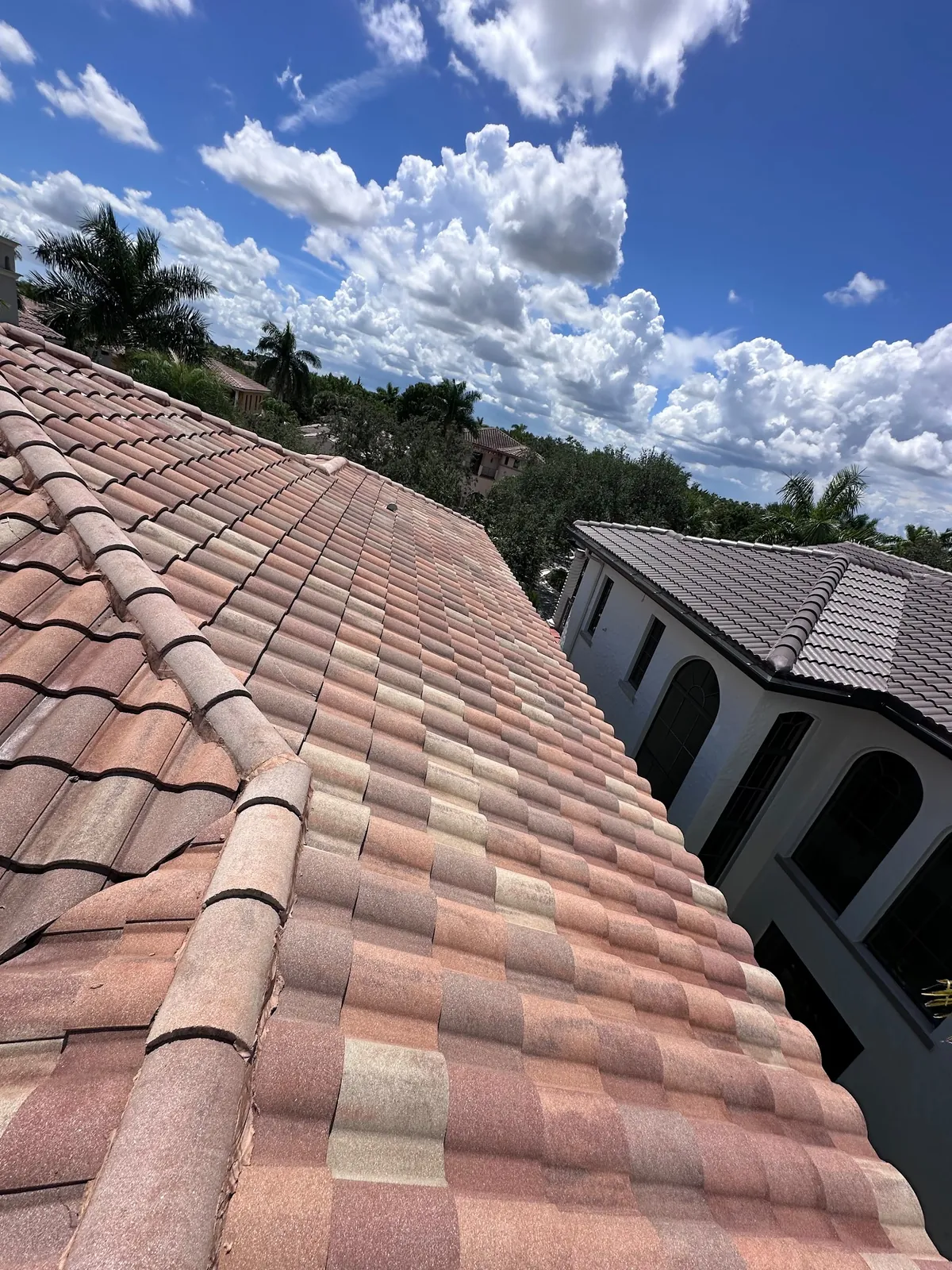
On tile roofs, the tile is the first line. The real waterproofing is the underlayment, a membrane fixed to the deck beneath. In Sunrise attic heat it dries and becomes brittle over time. Water that gets past a cracked or shifted tile then reaches the deck. A tile repair that goes well therefore involves more than new tile: the pro lifts the tiles around the damage, checks the underlayment and the deck, replaces what is failing, and relays the tile.
Ask the pro how far they plan to open up and why. On a townhouse row, also ask whether the repair will cross onto the section next door.
Keeping a row looking like a row
Townhouse rows are designed to look uniform, and associations usually want them to stay that way. When tile is replaced on one section, the new tile should match the colour and profile of the rest of the row. That can be harder than it sounds on a roof from the 1980s, because the original product may no longer be made and sun fading changes the colour of what is up there.
Ways a pro handles it: sourcing a close current match, using salvaged tile from the same row if the association keeps spares, or taking sound tiles from a less visible slope for the front and putting the new ones at the back. Ask which approach they suggest. If the association approves materials, get that approval before the tile is ordered.
Gable vents and driven rain
Many houses and end-unit townhouses from these decades have vents in the gable ends, the triangular walls under the roof peaks. In a strong storm, wind can push rain straight through the louvres into the roof space. The result looks like a roof leak, often on a ceiling near an end wall, but the roof covering itself may be fine. The pro checks the gable vents along with the roof, and can suggest a fix if they are letting water in.
Permits for older roofs
Roof repair in Sunrise on a roof built before the current wind rules often means bringing the repaired section up to today’s standard. Broward County is inside Florida’s High-Velocity Hurricane Zone, and repairs past a certain size need a permit and an inspection. The licensed roofer handles the permit. On a townhouse row, the association may also want to see it. Ask the pro at the inspection whether your repair needs one, and how that affects the timing.
Storms on a row of homes
High wind does the most damage to roofs here. On a townhouse row, it loosens the end of the row first, lifts tile along ridges, and can peel the caps off fire walls. On a detached house, it targets the ridges, the edges and the side facing the wind.
When the storm has passed and it is safe:
- Look along the row from the street for broken lines of tile or missing shingles.
- Check the tops of the fire walls for missing or shifted caps.
- Look at the eaves for soffit that has blown out.
- Gather debris in the yard and keep it.
- Watch upstairs ceilings and closets for several days.
On a shared roof, share what you see with the neighbours and the association, with photos. If a section is open, the pro can put a temporary cover or tarp on before the repair. Do not climb up.
Building a record for insurance
When storm damage leads to a claim, the insurer will ask what was damaged and how. That conversation is between you and your insurer; the roofer is not an adjuster. You can bring three things to it: your own dated photos, inside and from the street; the roofer’s photos from the roof; and the roofer’s written description of the damage and the repair. On a shared roof, the association may want the same set, and a neighbour making their own claim may ask for it too.
Soffit and fascia along the row
On a townhouse row, the eaves run the full length of the building. A rotten patch of fascia or a missing soffit panel at one home can let rats or birds into a roof space that may continue above the homes next door. The pro replaces rotted fascia, refits or replaces soffit and checks the drip edge so rain falls clear. Rows in an association usually have a set trim colour, so check before the roofer orders material. If animals are already living in the roof space, a wildlife professional needs to remove them before the openings are closed, or they will simply chew a new way out.
From your call to the repair
Here is how it runs:
- You describe the problem. Where the water shows, which floor, whether it is beside a party wall, whether you are in an end or a middle unit, and who maintains the roof.
- One Call picks the pro. A vetted roofer, licensed and insured for your roof type, who works in Sunrise.
- Access is sorted. Where the work crosses onto a neighbour’s section, or the association wants notice, that is arranged before the date.
- The pro inspects. They find the source and explain the repair, and you ask what the price covers before saying yes.
- The repair is made. A permit, if the work needs one, is applied for by the licensed pro.
- One Call follows up. If the next storm shows a drip, let us know and we take it up with the pro.
You pay One Call for the job, and One Call pays the pro. For larger roof work, financing is available; ask about it when you call. If the roof has failed more widely than a repair can fix, the pro will tell you. The roofing pros One Call works with also do full re-roofs, and on a townhouse row a re-roof usually involves the whole building.
The same roofing help is arranged next door, through roof repair in Tamarac and roof repair in Plantation.
Questions from Sunrise
The leak is right beside the shared wall. Is it my roof or my neighbour’s?
It may be either, or the fire wall itself. Water at a party wall usually comes from the wall cap or the flashing on one side. The pro may need to look at both sections to find it, so speak to your neighbour early.
Can my section be repaired without touching the neighbour’s?
Sometimes. Repairs at the party wall often cross the line, because the flashing and the cap serve both homes. If they do, the neighbour, and perhaps the association, need to agree first.
Why is there water on my ground floor when the roof is two floors up?
On a two-storey townhouse, water can run down inside a wall and appear well below where it got in. Check the upstairs ceiling above the damp and mention both places to the pro.
Does my association need to know about a roof repair?
Many in Sunrise want notice of any roof work, and some approve the materials. Ask the management office before the work date.
Book the roof repair
Tell us where the water shows, what kind of home you have and where it sits in the row. One Call matches you with a vetted, licensed roofer in Sunrise and stays with the job until it is done.